

Most of us never get proper time to think something through
You might have a transition ahead: a new role, a move, retirement, a change of direction. Or you’ve hit a stale patch and something doesn’t feel right. Or you’re looking to reinvent what you do. Whichever it is, there’s something big you need to work through, and you can’t find the space and time. An away-day doesn’t touch it, and it takes a couple of days just to stop thinking about your inbox.
So we built this. A few days on foot, a small group, and conversation with people who are curious about you and have no stake in your answer. You bring something to think about. The path, the people and the pace do a lot of the work. So does the coaching: two coaches who listen closely, ask the questions that move you on and stay on your agenda, and who also show up as real people, sharing what they’re working on, being open and building connection that lasts.
It isn’t a course, there are no slides. It isn’t a retreat, there’s no spa. And it isn’t a test of fitness.
Something you bring: a question, a decision, a transition, or just the need for proper space to think. The group are thinking partners, not an advice panel.
How we connect, on the walk and in the rest of your life. Practised as much as discussed, because it’s a skill rather than a personality trait.
The rhythm, the landscape, time away from screens, and an Italian pilgrimage route people have walked for centuries. Villages and cafés along the way, nowhere wild, and no race: we walk at the pace of the group.
John and James listen closely, ask the questions that move you on and stay on your agenda. They also show up as real people: sharing what they’re working on, being open and vulnerable, and building connection that lasts.
We went. Here’s what happened.

In the first week of October, four of us walked part of the Camino del Norte along the Basque coast: John and James, and two others who’d agreed to be the first. Three days on foot with a day either side to travel: about 20 km a day and six to eight hours including breaks, 61 km and around 1,500 m of climbing in all. A light-touch test, a chance to find out what the idea really was before asking anyone else to give it three days.
What we found is that the idea holds up. The conversations started on the first morning and barely paused. Six to eight hours a day just happened, and the walkers said the same. We paired up and swapped at crossroads and after lunch, so each of us could give one person our full attention for a stretch, then hand over and start fresh with someone new. With four people it felt seamless. The conversations started deep and powerful, and kept growing deeper and more profound through the days, leading to really transformational conversations about what shaped us, what we want to carry forward and what we’re ready to put down.
“The depth came from how John and I showed up, not from a method.”
James, writing up his notes from the walk
One moment sums up how deep into the journey we were. On the last day we reached a fork where John, who’d walked it before, remembered getting lost on that very spot. We could take the road, go back the way we came, or try a marked path none of us knew. Nobody needed persuading. By then the group was curious, trusting each other and in the middle of its own growth, and everyone said that way. It turned out to be one of the best stretches of the trip.
By the last day the word that came up was clarity. We’d add conviction: both walkers left with a clearer next step and the confidence to act on it, in very different directions.
“It’s that shift from having an insight to knowing something. That’s the piece I think is really important.”
James, in conversation with John after the walk
What the walk gave us
The coaching conversations, the walking and the people did most of the work. Here is what stood out.
From the first morning the hours disappeared. We dialled up our attention on each person, stayed on their agenda, held the space, asked questions and came back to what they’d said earlier. We also shared some of ourselves and were open about what we were working on. That is what carried the days.
There’s no eye contact and the view keeps changing, so it feels lower stakes. It’s easier to say the bigger things, to be a little vulnerable, and to admit that something should change.
We do the coaching, and we each brought something of our own too. That mutual sharing, with a little vulnerability, creates something good. A two-way conversation worked better than being coached by one person.
People have walked these paths for centuries. You pass other walkers, villages and the odd ‘Buen Camino’, and you feel part of something bigger than your own agenda.
We sent questions to reflect on about a month ahead. People turned up already thinking, and ready to talk.
The walking days are deep and reflective. Dinner was relaxed, playful and a lot of fun, a decompression that came from the depth of the day. Connection needs both.
Insights can take time, and often do. The shift that matters is from understanding something to knowing it, as a real belief, in your body and not just your head. Then comes the change: doing something with it. Three days gives all of that room.
A well-chosen group, fully present, over several days and away from the everyday. There’s a depth of presence in that which is hard to find elsewhere, and connecting people to others they should know may be a real reason to come.
Still working out
Four people is a small test. John knew everyone, and the group was warm and very alike, which was lovely and also meant fewer assumptions got challenged, so we’re thinking hard about the mix. We were so absorbed in the conversation that we barely noticed the coast, and we haven’t yet tried the quiet stretches. And we’re still waiting on what the walkers tell us in their own words, and whether the connections last. We’ll be back together on a call in late November, and we’ll update this page when we know.
For anyone exploring a transition
You don’t need a big problem. You do need something that matters to you and some space to work on it. People most likely to get a lot from this are in one of these places:
A new role or a big step up, a move, retirement, or deciding whether to leave the corporate world and do something else.
Senior and successful, but something has gone flat, and you want to rediscover what you need from your work or where to go next.
You don’t want a different job, you want a different way of doing this one: where your own agency is, and the courage to try something new.
Openness, a willingness to share, and the courage to try a different view. Everything else is a mix we welcome: different ages, levels and backgrounds, because it makes for better conversations.

How a day actually went
This is Sunday, the first walking day, as it ran. Not a timetable, just a shape. We hold the schedule loosely and decide the start the night before, and walkers told us they liked that. Your diary just says walk, talk, connect.

A quick coffee, then four of us in one taxi to the start, about twenty minutes. Everyone was full of excitement for the day, and ready to talk through what they’d been thinking about in advance.
Conversation in pairs, and the pairs move on at a crossroads or after lunch. Each pairing builds on the last.
A coffee and a snack about an hour and a half in, a drink an hour and a half after that, then lunch. On the first day we were stopped for over three hours out of eight, and plenty of the talking happened right there.
Back at the hotel by about a quarter to five, with a few hours of your own before dinner.
Drinks at seven, then dinner until about nine. A bit of storytelling, a bit of reflection, and a lot of laughing.
It isn’t a race. We walk at the pace of the slowest, and there are places along the way to stop, or drop out. Monday finished early enough for a late lunch and an afternoon swim in the sea, which was a highlight.
Why three days in a row
One coaching session moves you in a direction, and then the effect has a half-life. It fades, and a month later you start again. Three days back to back keeps building. Each conversation picks up from the last, and you step into the next one with a slightly different view: a little progress, then a little more, then a little more.
“After every session there’s a little increase and then there’s a dip. This more intense approach is a really interesting alternative.” John
What we’re adding
The pilot gave us a long list. This is the short version of what we’re planning, to be confirmed once we’ve finished our review.
We’ll get everyone together the night before, and open the first morning with a proper check-in.
You’ll tell us beforehand what you’d like to talk about, and we’ll share it, so everyone starts able to ask the bigger questions.
A quiet stretch, an evening question and a thinking-partner stretch (one person talks, the other only listens and asks), to see whether they earn their place.
Enough variety for different views, small enough for real time with everyone, and room for walkers to work with each other as well as with us.
A keepsake with the date and place on it, and a chance to tell us what you made of the experience and of us.
It doesn’t end when the walk does
Most time away changes how you feel for about a week. That’s the problem with it. Knowing this, we’ve shaped the experience so that it continues back into your real life, supporting ongoing change, growth and development, and helping you embed the positive behaviours and processes you’ve learned along the way.
You bring together what you’ve talked about and decide what you’ll stop, start or keep. Then you write a letter to yourself about what you’ve realised or decided.
Your letter arrives in the post. It’s a surprisingly direct way of finding out whether anything actually changed.
The group meets again online to compare notes on what stuck, and what didn’t.
Walking with John and James
We both care about connection, we both love a long walking trip, and we both believe time like this can be transformational for people.
We’ve each done a huge amount of leadership and management development, coaching and team development. What draws us to this is the chance to create more impact: transformational, lasting impact that stays with people long after they’re home.
For John it began with friends who walk together once a year and kept calling it the best three days of their year. For James it was noticing that his best thinking and his best conversations happen on the move. Put the two together and you get this.
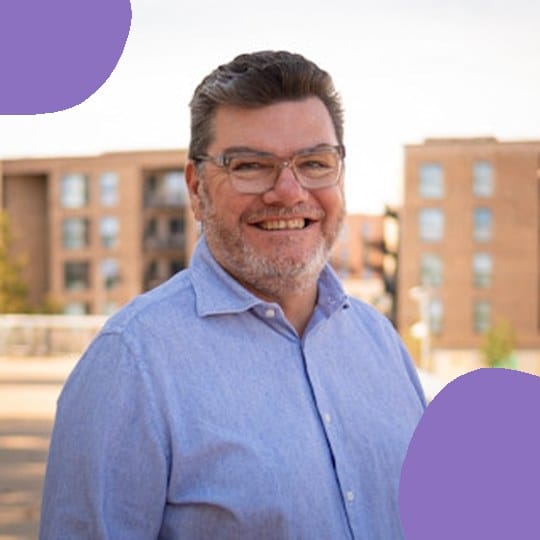
Executive coach John Maxwell, a former engineer and CEO, brings decades of experience guiding leaders through complex transitions and decisions. His global career in advanced materials took him across the US, China, Germany and Belgium.
While completing the Advanced Management Program at Harvard Business School in 2010, John discovered that leadership is a truly learnable skill. Since 2017 he has spent over 2,000 hours coaching leaders across technology, law, strategy consulting and beyond. His love of the outdoors and walking inspired him to create an environment for deep thought and connection.

Coach and facilitator James Carrier, a former chartered accountant, grew up in the US, and his career in financial services took him across the UK and Europe. Delivering large-scale business integrations in the early 2010s, he saw first-hand the power of great connection, team dynamics and leadership — not just in driving business performance, but in improving people’s quality of life.
Since then he has worked with teams and leaders around the world on exactly that. James leads a running group and a community of facilitators in Edinburgh, and his love of the outdoors, from long walks across Europe to the trails on his doorstep, inspired him to take coaching into the open air.
The essentials

An Italian pilgrimage route, walked for centuries. We’re choosing the route now and will confirm it here and in our next email. Our first walk followed the Camino del Norte on the Basque coast, between Itziar, Zarautz and San Sebastián.
16 to 20 April 2027. Travel out on Friday 16th, walk Saturday 17th to Monday 19th, and travel home on Tuesday 20th.
Six in all: four walkers, plus John and James.
Three walking days of about 20 km, six to eight hours including breaks, with a shorter day built in. It isn’t a race, and we map places along each day where you can stop. Scenic rather than savage, but a full day on your feet, three days running. We’ll tell you how each day grades, for exposure as well as distance.
Five days door to door: a day to travel in, three days walking, and a day to travel home.
Your own room in a comfortable hotel, two nights in each place, with breakfast and dinner together. We’ll confirm exactly what’s included when we share the price.
We’re still working this out and will share it before places open.
You arrange your own travel. We’ll share guidance on getting to the start and home again once the route is confirmed.
Some questions to reflect on, sent about a month ahead (30 to 45 minutes’ worth), a short welcome call, and one question from us: what would you like to talk about? Please make sure your travel insurance covers walking.
Things people ask

Do I need a big problem to bring?
No. A question, a decision, a vague sense that something needs attention, or simply wanting space to think are all plenty.
How much will I have to share?
As much or as little as you like. Everything is an invitation, and you can always pass.
Is it non-stop talking?
On the pilot, nearly. The walking days are a gentle kind of intense, with nowhere else to be, and the evenings are lighter and more playful. We want to build in more quiet too, and you can always walk on your own for a while.
Is it coaching?
Of a sort, yes. It’s coaching-led: question-led and exploratory, always on your agenda, with the courage to challenge when it helps, and with real attention on building relationships, between all of you as well as with us. It’s also two-way. What we heard on the pilot is that a mutual conversation works better than being coached by one person, so we share too.
What if I don’t click with someone?
It happens. We mix the pairs through the day, and there’s always time on your own.
Do I need to be especially fit?
You need to be comfortable walking for most of a day, three days in a row. You don’t need to be fast: we walk at the pace of the slowest, and it isn’t designed as an endurance challenge.
What if I’m not good with heights?
Tell us. One day on the pilot had a ridge with some exposure and not everyone loved that stretch. We’ll describe each day in advance so you know what’s coming.
Is there homework?
A few questions to reflect on before you go, and a letter to yourself at the end. That’s it.
The research behind it
The walking, the time away, the company and the days themselves are there for a reason. This is the thinking, and where it comes from.
Your brain is constantly predicting what’s about to happen, based on what it has learned. Everyday life mostly confirms those predictions, the same places, the same people, the same conversations, so not much changes.
New places, new people, physical effort and quiet all create small mismatches: moments where what happens isn’t quite what you expected. That’s when the brain updates. Walking and nature turn down the ruminating loop, people with no stake in your answer offer a view you can’t get from inside your own life, and a few days gives it time to settle.
We also have a simple way of looking at whatever someone brings: the world first, then yourself, then the people around you. We planned a theme for each day along those lines. It never came up on the pilot, so we’re testing whether it earns its place.
An honest note. Most of these studies are small, and many show links rather than proof of cause and effect. Our own pilot is four people, a first data point and no more. We’re not promising outcomes. We’re putting together the conditions the research suggests are good for thinking and connecting, and paying attention to what actually happens.
The studies, one by one
People came up with around 60% more creative ideas while walking than sitting.
A 90-minute walk in green space reduced rumination, and activity in a brain region linked to it.
After four days in the wilderness without phones, hikers scored about 50% higher on a creative problem-solving test.
We expect conversations with people outside our circle to be awkward. They’re more rewarding than we think, and deeper ones more so.
People who had just walked in step with each other cooperated more afterwards.
The quality of our close relationships is one of the strongest predictors of health and happiness later in life.
A weekly ‘awe walk’ increased joy and reduced day-to-day distress.
- Atchley, R. A., Strayer, D. L., & Atchley, P. (2012). Creativity in the wild: Improving creative reasoning through immersion in natural settings. PLOS ONE, 7(12), e51474.
- Bratman, G. N., Hamilton, J. P., Hahn, K. S., Daily, G. C., & Gross, J. J. (2015). Nature experience reduces rumination and subgenual prefrontal cortex activation. PNAS, 112(28), 8567–8572.
- Epley, N., & Schroeder, J. (2014). Mistakenly seeking solitude. Journal of Experimental Psychology: General, 143(5), 1980–1999.
- Holt-Lunstad, J., Smith, T. B., & Layton, J. B. (2010). Social relationships and mortality risk: A meta-analytic review. PLOS Medicine, 7(7), e1000316.
- Kardas, M., Kumar, A., & Epley, N. (2022). Overly shallow?: Miscalibrated expectations create a barrier to deeper conversation. Journal of Personality and Social Psychology, 122(3), 367–398.
- Oppezzo, M., & Schwartz, D. L. (2014). Give your ideas some legs: The positive effect of walking on creative thinking. Journal of Experimental Psychology: Learning, Memory, and Cognition, 40(4), 1142–1152.
- Sturm, V. E., et al. (2022). Big smile, small self: Awe walks promote prosocial positive emotions in older adults. Emotion, 22(5), 1044–1058.
- Waldinger, R., & Schulz, M. (2023). The Good Life. Simon & Schuster.
- Wiltermuth, S. S., & Heath, C. (2009). Synchrony and cooperation. Psychological Science, 20(1), 1–5.
Further reading on our site: The Predictive Brain · Information Doesn’t Change Behaviour. Here’s What Does. · Loneliness Is a Health Crisis, Not a Feeling · A 90-Minute Walk in Nature Measurably Changes the Brain

Register your interest
We’re keeping groups small, four walkers and the two of us. Tell us a little about yourself and you’ll hear first when places open. There’s no commitment, and we’ll follow up with a conversation, not a sales pitch.