


Part 3 of 3 · A series by Brian Hunter Young
- What If Organisation Development Has Been Looking in the Wrong Place?
- Could Better Questions Lead to Better Organisation Development?
- Who Decides What Organisational Values Really Mean? (you are here)
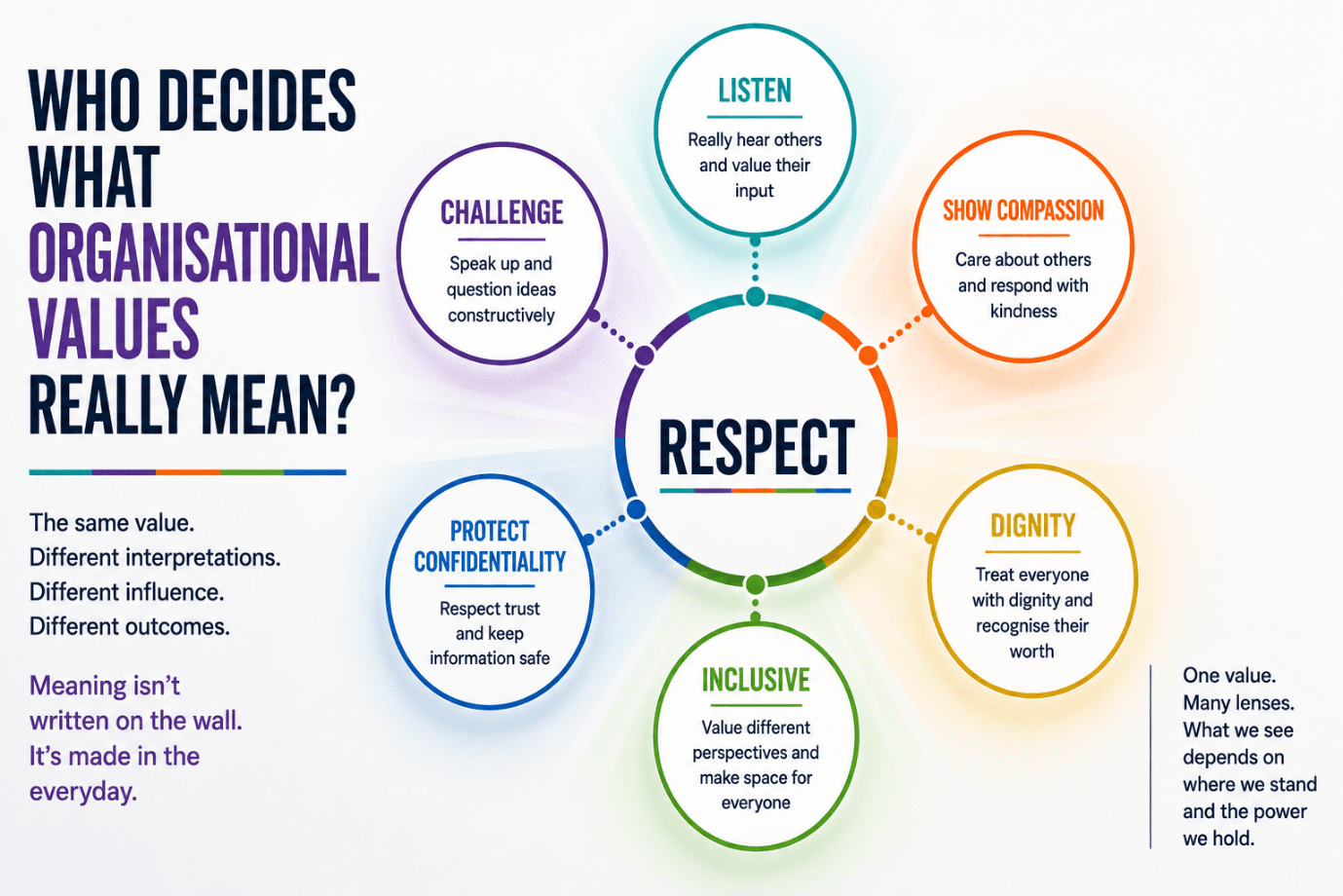
The same value. Different interpretations. Different influence. Different outcomes.
When Organisational Values Become Personal
Organisational values have interested me for a long time because they can become deeply connected with how people experience working life. Like many people, I have worked in organisations that invested considerable effort in defining what they stood for and the behaviours they hoped to encourage. My own experiences also prompted questions about what happens when stated values encounter the complexity of everyday decisions, relationships and different positions of formal, perceived or assumed power.
Those questions eventually helped shape the focus of my Master’s dissertation a few years ago. I also want to acknowledge four alumni friends and colleagues, Louise Dobbie, Joe Bell, Mark Leyshon and Alistair Wylie, whose encouragement, conversations and different perspectives inspired me and helped me recognise organisational values as an area worthy of deeper enquiry and reflection.
The subject connected directly with my professional experience and a growing curiosity about what organisational values mean when they encounter the realities of working life. Experiences involving trust, confidentiality, dignity and respect had led me to think more deeply about how people interpret organisational values, how those values influence behaviour, and how they are experienced through the actions and decisions of others. My colleagues’ encouragement helped turn that curiosity into something I could explore more systematically through research.
My dissertation explored organisational values through the experiences of senior leaders, while also drawing explicitly on my own experience through an autoethnographic element. Participants described values in varied ways, including as sources of shared direction and organisational identity, while others offered different perspectives on how values influenced everyday organisational life. Those different experiences became an important part of what the research revealed.
A few years on, I am returning to that research with a broader set of questions. Alignment between stated values and everyday experience still interests me, while my attention is increasingly drawn towards what happens between them: how people interpret values, what happens when different interpretations meet, whose interpretation carries influence, and what patterns emerge as values encounter relationships, competing pressures and changing conditions. This opens up a different way of exploring organisational values, particularly at those moments when their meaning has to be worked out in practice.
When Values Provide Something to Hold Onto
Some participants described values in strikingly positive terms. One spoke about their potential to help people feel they were “in the same boat going in the same direction”. Another described values as an “anchor”, something sitting beneath the behaviours that others could observe. Another used the image of a “golden thread” running through the organisation. These accounts presented values as much more than corporate statements. They could provide shared direction, contribute to organisational identity and create a reference point for how people worked together.
What interests me now is how values acquire that significance in practice. Respect, compassion or openness become tangible through conversations, decisions and relationships, particularly when people are interpreting what those values require in changing circumstances.
When Values Are Experienced Differently
The research also revealed considerable variation in how organisational values were understood and experienced. Some participants placed greater emphasis on personal ethics than corporate values, while others reflected on differences between stated values and everyday workplace processes. The largest hindrance identified in the research concerned alignment between workplace dynamics or processes and organisational values, with values perceived as tokenistic and differences between individual and organisational values also featuring in the findings.
Looking at those findings now, that variation is particularly interesting because it suggests that people can encounter the same broad idea of organisational values from very different positions. Those differences provide useful material for understanding how values acquire meaning through organisational experience.
My own experiences added another perspective to these findings. One situation involved asking for confidentiality during a conversation about compassionate leave and subsequently discovering that the matter had been discussed more widely. Whatever the intentions of those involved, I experienced what happened as a breach of trust and found it difficult to reconcile with organisational values concerned with care, compassion, dignity and respect.
Another experience arose through a recruitment process. What stayed with me was not simply disappointment about an outcome, but how the process and subsequent response were experienced. Again, I struggled to reconcile what happened with values concerned with openness, honesty and responsibility.
Looking back, I think there is an important distinction here. My experience tells me how I interpreted and experienced those situations. It cannot tell me with certainty how the other people involved understood their own behaviour, what intentions informed their decisions, or whether they believed they were acting inconsistently with the organisation’s values. They may well have understood the same circumstances very differently.
Recognising those different possible interpretations makes the question more interesting.
If two people can encounter the same situation, subscribe to the same stated organisational values and nevertheless understand what those values require very differently, perhaps the issue is more complicated than whether an organisation simply ‘lives its values’.
Values Do Not Act. People Do.
Values acquire practical meaning through people. Respect becomes visible in how decisions are made and disagreements are handled. Compassion becomes visible in how people respond to one another, while openness becomes visible in how information, questions and different perspectives are handled. People interpret and enact those values within the circumstances they encounter.
That interpretation takes place within relationships where people bring different experiences, responsibilities, professional perspectives and expectations. Influence may arise through formal authority, expertise, relationships, status or experience. Power may also be perceived or assumed, shaping how people interact regardless of what an organisational chart formally assigns.
This raises a question I did not explicitly set out to investigate in my Master’s research:
What happens when people interpret the same organisational value differently and one person’s interpretation carries greater influence over what happens next?
Consider respect, the value at the centre of the visual accompanying this article. It might be expressed through listening, challenge, confidentiality, dignity, inclusion or compassion. These expressions can coexist, while particular circumstances may bring different interpretations to the foreground. Protecting confidentiality, for example, may need to be considered with responsibilities to share information, while challenging someone’s position may itself be understood as an expression of respectful practice.
This expands how I now think about alignment. Shared values remain important, while differences in what people understand those values to require may also provide useful information. Rather than treating Difference primarily as something to resolve, there may be value in becoming curious about what it reveals. That is one of the places where my thinking has developed since completing the research a few years ago.
What I Notice Differently Now
When I completed my Master’s research, alignment between individual and organisational values was an important part of how I understood the findings. It remains valuable, particularly where shared values contribute to common purpose and provide reference points for behaviour. My developing praxis in Human Systems Dynamics (HSD) is now adding another perspective by encouraging me to pay closer attention to Difference and to what differences may reveal about a human system.
That changes the questions I bring to my earlier research. When people interpret a value differently, I am interested not only in whether greater alignment is possible, but in what the Difference might be telling us. HSD also draws my attention towards Exchanges: the information, questions, challenge, feedback and interpretations that move between people. If somebody questions whether a decision reflects a stated value, their ability to contribute tells us something; how that contribution is received and what happens afterwards may tell us considerably more.
This draws my attention from individual experiences towards recurring patterns. Each interaction provides information, while looking across interactions may reveal more about how values are repeatedly interpreted and enacted as conditions change. Openness may take one form where there is broad agreement and another when an uncomfortable question is raised. Compassion may also be expressed differently when time, resources or other pressures change.
This adds another question to “Does this organisation live its values?”: “What patterns emerge around those values under different conditions?”
This makes me curious about what happens to Difference: whether it introduces information that changes how a situation is understood, how different interpretations influence one another, and what patterns emerge when different perspectives and positions of influence meet.
Agreement on values such as respect, compassion, openness, dignity or inclusion may therefore be a starting point rather than an endpoint. Their meaning continues to develop as people work with them through uncertainty, competing responsibilities, different perspectives and changing conditions.
This developing perspective also has relevance to the early planning of my intended doctoral research, which is exploring how leadership behaviours, relational dynamics and system conditions interact to enable or constrain collective action and transformation across organisational, professional and formal authority boundaries. HSD is being considered as a sensitising framework within that developing qualitative approach, helping me remain attentive to patterns and relationships without determining in advance what the research should find.
Revisiting my Master’s research has made that distinction more tangible. The opportunity is to remain curious about what is happening, what patterns are forming, under what conditions they change and what those patterns appear to make possible. My earlier research drew my attention strongly towards alignment; I am now also interested in what Difference might reveal, what happens through Exchanges between people and how patterns develop as conditions change. This builds on what I learned then and opens another way of looking at organisational life.
What Else Might We Ask About Organisational Values?
Organisations will probably continue to invest considerable time in identifying and articulating their values, and there can be real value in doing so. My earlier research provided evidence of values offering shared direction, contributing to organisational identity and providing reference points for behaviour. A few years on, I am interested in what becomes visible when we place additional questions beside those concerned with alignment and shared meaning.
Some of the questions now attracting my attention concern what happens when people interpret the same value differently, what those differences can reveal and how different perspectives shape what happens next. When someone questions whether a decision reflects a stated value, the exchange that follows may also tell us something important about how that value is being experienced and enacted.
This perspective also encourages me to see Difference as potentially informative. Someone questioning whether a decision reflects compassion, dignity, openness or respect may be introducing an experience or perspective that helps others see something differently. Paying attention to recurring interactions can then help us notice how interpretations develop, what patterns become established and how those patterns respond as conditions change.
A few years ago, my research led me towards questions about alignment between individual and organisational values. Those questions remain relevant. I would now place others beside them: What differences are inviting our attention? What patterns keep repeating? Under what conditions do those patterns change? And what new possibilities might become visible when we pay attention to them?
That brings me back to the question at the centre of this article: Who decides what organisational values really mean? I am increasingly interested in the possibility that their meaning is continually shaped through relationships between people who bring different experiences, responsibilities and degrees of influence to those encounters. The question may therefore be valuable not because it leads us towards one definitive answer, but because of what becomes possible when we continue to explore it.
About the Author

Brian Hunter Young is an experienced leader and doctoral researcher with more than 20 years’ experience across health and social care, organisational development, health improvement, and the voluntary sector in Scotland. His intended research at the University of Stirling will explore how leadership behaviours, relational dynamics and system conditions influence transformation across organisational and professional boundaries.
Brian’s wider interests include leadership, organisational change, Human Systems Dynamics, and making sense of complexity. He is particularly interested in how people can work together effectively in uncertain and changing conditions, creating possibilities for learning, collective action, and meaningful change.
Connect with Brian on LinkedIn.
Sources and Feedback
This is a guest article. The views expressed are the author’s own.
We’re a small organisation who know we make mistakes and want to improve them. Please contact us with any feedback you have on this post. We’ll usually reply within 72 hours.
