TLDR
Before the film, almost every feeling people wrote down was negative and passive: overwhelmed, doom, exhaustion, grief and numbness. But when we asked how we could help each other, the answers were simple and hopeful: empathy, reaching out, and looking after ourselves so we can be there for others. Connection matters.
Introduction
Most conversations about climate change skip a step. We go straight to the facts, the arguments or the solutions. Or, more often, we quietly change the subject. What we rarely do is stop and ask how it actually feels to live with it.
That step matters. How we feel shapes what we do, or don’t do, and more information on its own rarely changes behaviour.
So on Wednesday 28 October, People Peeps, the Edinburgh learning community I co-organise, tried something a bit different. Stuart Moncrieff and I hosted an evening about the feelings, not the science.
This is what we did, what people told us, and what we took from it. If you’d like to run something similar yourself, there’s a simple recipe near the end.
Why we ran it
People Peeps usually focuses on organisational and people development: leadership, coaching, wellbeing, culture. Increasingly, though, we want to make room for the bigger subjects that affect all of us, at work and beyond it. Climate change is one of the biggest.
My view is that whatever we think or feel about climate change, we’re better able to respond well if we’re connected to each other. And talking honestly about how we feel is one of the quickest ways to build that connection.
So the evening had no right answers, no debate to win, and no one telling anyone what to think. Just a space to notice our own reactions and hear other people’s.
What we did
Fifteen of us met at Codebase in Edinburgh for a little over two hours. The shape of the evening was simple:
- Post-its first. Before anything else, everyone wrote a few words on how they feel when they think about climate change.
- A short introduction from Stuart and me to set the scene.
- The film. We watched the National Emergency Briefing, a 50-minute film based on a briefing given in Westminster in November 2025, where leading experts set out the latest evidence on climate and nature to politicians and other leaders. It’s very UK-focused, covering health, food, infrastructure and the economy, and it’s frank about the risks as well as about what’s still possible.
- A playback. After a moment to reflect, we shared back what the post-its said, sorted onto a simple grid.
- Small groups. Three groups talked about what came up for them while watching, and how we might help other people navigate their own emotional responses to climate change.
- A debrief all together, and then a drink next door for anyone who fancied it.
Where our feelings landed
We sorted the post-its on two dimensions. The vertical axis ran from positive to negative. The horizontal axis ran from passive to active: feelings that hold us still on one side, and feelings that move us to do something on the other.
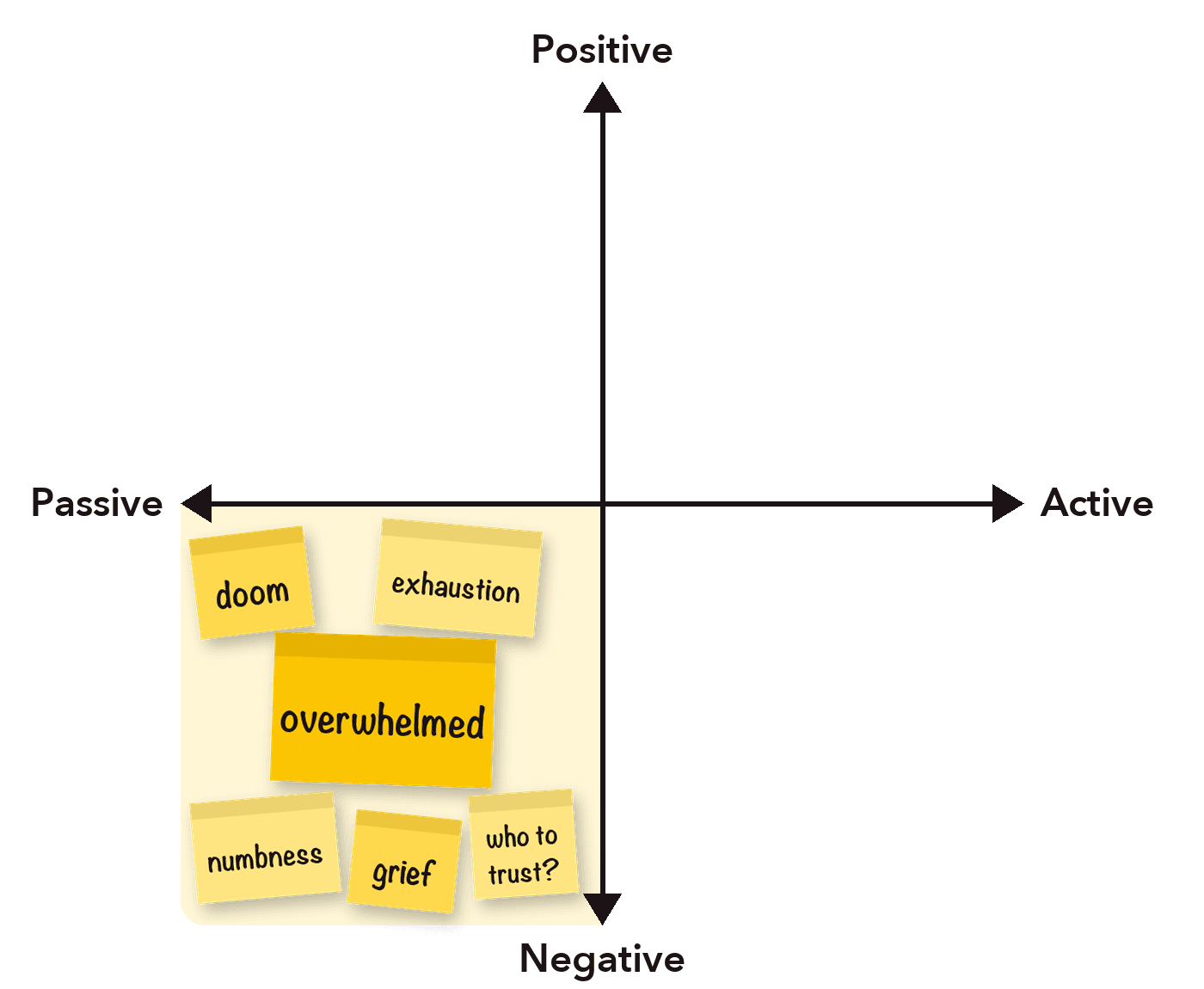
Unsurprisingly, the vast majority landed in the same corner: negative and passive. A few sat elsewhere, but not many.
Overwhelmed was the word that came up most. Doom and exhaustion were there too, along with a quiet sense of grief. There was a theme of numbness, of feeling nothing any more. And several people wrote about not knowing who or what to trust, and how tiring that is in itself.
Why that corner matters
The negative feelings aren’t the problem in themselves. Grief and worry are reasonable responses to something this big. What struck me more was how passive they were.
Overwhelm tends to arrive when a problem feels far bigger than anything we can influence. The natural response is to pull back or switch off, and numbness can be a way of protecting ourselves when there’s simply too much. Not knowing who to trust adds to the load: if you can’t tell what’s true, doing nothing can feel like the safest option. The circle of influence is one useful way to think about this, separating what we can affect from what we can only worry about.
None of that is a personal failing. But it does suggest that more facts, delivered more urgently, may not be what most people need first.
What came up during the film
In the small groups, the strongest theme was a sense of loss, or grief. Alongside it came frustration and irritation, and for some a kind of indifference: a feeling of already being so overwhelmed by everything else that there’s nothing left to feel with.
What helps
This is where the room turned. When we asked how we might help other people with their own responses, the conversations had real warmth and hope in them. The answers were simple things any of us can do:
- Empathy: meeting people where they are, rather than arguing with them.
- Reaching out to each other, so no one has to carry this alone.
- Looking after ourselves, so we’re in a better place to be there for others.
Most of all, people kept coming back to the power of genuine human connection. That fits with a lot of what we write about: connection is not a nice-to-have, and it is often what helps us move from feeling stuck to doing something.
The evening itself was a small example. A room of people, many of whom had only just met, able to say “I feel overwhelmed” and be heard. It’s a reminder that conversations with strangers can go deeper than we expect.
Connection matters.
How to run one yourself
We’d love more conversations like this to happen. You could host conversations like this about a wide range of important topics, not just climate change. And you don’t need us to run a session like this. Here’s the recipe we used:
- Start with post-its, before anyone has heard anything from you. It captures where people really are.
- Sort them on a two-by-two grid: positive to negative, passive to active. It gives the room a picture of itself, quickly and without singling anyone out. (you could use another 2×2, if you wish)
- Use a shared stimulus. Anyone can host a screening of the film, and the organisers provide a screening guide and a discussion guide. Again, similar “provocation” resources exist for a wide range of important topics.
- Keep the groups small and the questions open: what came up for you, and how might we help others?
- Leave room to decompress afterwards. A café or pub nearby does a lot of work.
If you’d like to talk through how we ran it, get in touch.
What’s next
We may run this again in Edinburgh. If you’d like to be involved, or help shape it, let us know.
In the meantime, People Peeps carries on. We do in-person sessions here in Edinburgh, and some online sessions too. You can check out upcoming sessions and register here on Meetup, browse every People Peeps session so far, or join our mailing list to hear about the next one first.
Sources and Feedback
This piece draws on our own notes from the session on 28 October 2026 and the post-its people shared. We’ve reported themes only, not individual comments. The film is the National Emergency Briefing. We’re a small organisation who know we make mistakes and want to improve them. Please contact us with any feedback you have on this post. We’ll usually reply within 72 hours.