


The Hedgehog Concept
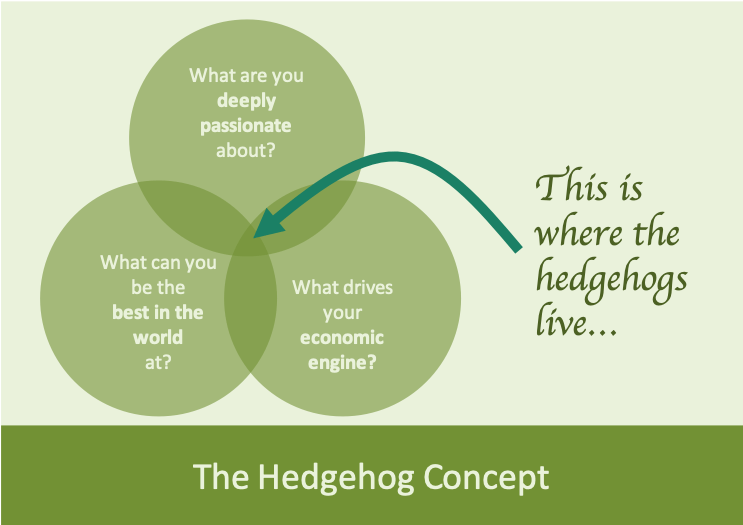
The model argues that being very good at one clear thing (your “hedgehog concept”) is strategically better than trying to do many things. It says that organisations should seek to find their own hedgehog concept at the intersection of three areas:
- What they are passionate about,
- The things they believe they can be the best in the world at, and
- The things they can make money from.
Where the Name Comes From
The name “Hedgehog concept” derives from the ancient Greek poet Archilochus who wrote that “Foxes know many things, but the hedgehog knows one big thing”. There are many different interpretations of this phrase, but in this post we focus on the way that it relates to Jim Collins’ work.
For the purposes of this post, the Greek saying captures the fact that foxes have many different tricks to try and eat hedgehogs, but hedgehogs have just one tried and tested response, to curl into a protected ball.
This one thing that they can do very well is the key to their effective defense, and the basis for this model’s concept as well as its name.
Finding your Hedgehog Concept
The model says you can find your organisation’s “hedgehog concept” by assessing what your organisation is great at doing, what it makes money from and what its people are passionate about.
A product, service or offering that fits into all three of these categories may become your organisation’s “hedgehog concept”.
To find your organisations hedgehog concept it may be worth considering the following steps:
- Find out what your people care about and are most proud of. Identify what you’re most passionate about.
- Honestly assess what you’re good and bad at. Identify things you could be a world leader at doing.
- Assess the profitability of your offerings. Which ones generate attractive returns based on your measures?
- Compare your assessments and look for overlap. Are there offerings that appear in all three circles? Choose your hedgehog from among the offerings that you’ve identified as meeting all three criteria.
Once you’ve Identified Your Hedgehog
Once you’ve identified or chosen your “hedgehog concept” then you should seek to focus almost exclusively on this service, product or offering. Your first step should be to define your strategy around it and then to communicate your strategy to your teams.
Learning More
This topic crosses over with strategy, which we’ve introduced in our posts on the VMOSA framework and Strategy Management framework. You might also enjoy learning about porters five forces and vision and mission statements
This model basically says that it’s good to have a focused strategy, play to your strengths and ensure your team is engaged. It’s a fine, basic message and the hedgehog analogy makes it accessible. organisations do benefit from having a clear purpose, vision, product offering and customer base and this model may help them identify where to focus their resources.
That said, organisations also need to respond to a changing world, experiment, learn new things, acquire new skills, shape new markets, respond to new challengers, adopt new technologies and create new products. They’ll never do that if they just do one thing well.
We also believe that this model is founded on the underling principle that organisations should focus on maximizing shareholder returns. We think that organisations should do more than this, and we’re not sure that this model supports the complexity and nuance of trying to maximize stakeholder as opposed to shareholder returns.
Sources and Feedback
This post is based on the original work of Jim Collins as published in his book: “Good to Great”.
We’re a small organisation who know we make mistakes and want to improve them. Please contact us with any feedback you have on this post. We’ll usually reply within 72 hours.
